Do Cash-Only Ambulatory Surgical Centers Really Threaten Critical Access Hospitals?
An initial but potentially sufficient look at the question.

View/Download [PDF]
Rhoads, J. "Do Cash-Only Ambulatory Surgical Centers Really Threaten Critical Access Hospitals?" Center for Modern Health. October 2025.
In debates about rural health, the financial vulnerability of critical access hospitals (CAHs) has long been cited as a justification for protecting them from market competition. CAHs are facilities that have received the special CAH designation from the Centers for Medicare & Medicaid Services by meeting specific criteria, such as maintaining no more than 25 inpatient beds and providing 24/7 emergency care.1 CAHs receive cost-based reimbursement from Medicare, which helps to make them financially sustainable despite serving low-density populations. Proponents say these hospitals represent a lifeline for rural residents, providing not only emergency and inpatient care but also some outpatient and surgical services.
By contrast, cash-only ambulatory surgical centers (ASCs) operate outside traditional insurance reimbursement arrangements. They only accept direct, out-of-pocket payments from patients (or in some cases, employers), and in so doing, simplify the administrative processes and reduce the number and complexity of contractual relationships that other ASCs typically deal with.
ASCs operating on a true cash-only model remain rare but they have garnered increasing attention. Critics contend that cash-only ASCs may undermine the financial viability of CAHs, particularly in rural communities where healthcare resources are limited and CAHs often serve as vital providers of emergency and surgical care. In New Hampshire, a bill that would make it easier for cash-only ambulatory surgery centers to open has been resisted by legislators who have expressed concern over potential effects on nearby critical access hospitals. However, there is little to no robust data supporting the notion that such centers actually cause critical access hospitals to close.
Ambulatory surgical centers do not provide general hospital care. They specialize in performing surgical procedures on an outpatient basis, typically for less complex, elective surgeries (e.g., cataract removals, minor orthopedic surgeries, and diagnostic endoscopies).2 ASCs are generally designed to offer greater convenience, reduced wait times, and lower costs compared to hospital outpatient departments. The cash-only model is a distinct type of ASC wherein patients pay directly for services without involving insurance companies. This cash-pay approach often appeals to uninsured patients, patients seeking transparency in pricing, patients with high-deductible health plans, and patients who have been given some sort of shopper incentive (for instance, by an employer).
The hypothesis that cash-only ASCs diminish the revenue streams and patient volumes of CAHs, potentially causing hospital closures, is theoretically plausible but empirically underexplored. No comprehensive dataset or peer-reviewed study currently demonstrates a causal correlation between the opening of cash-only ASCs and the closure of CAHs.3 A simple visual inspection of the number of critical access hospitals over time in states such as Oklahoma, Texas, and California, where some cash-only ASCs have opened over the past twenty years shows a relatively stable number of CAHs in each state, not the kind of precipitous decline one might expect to see if cash-only ASCs really do pose a threat to CAHs. (See Figure 1.)
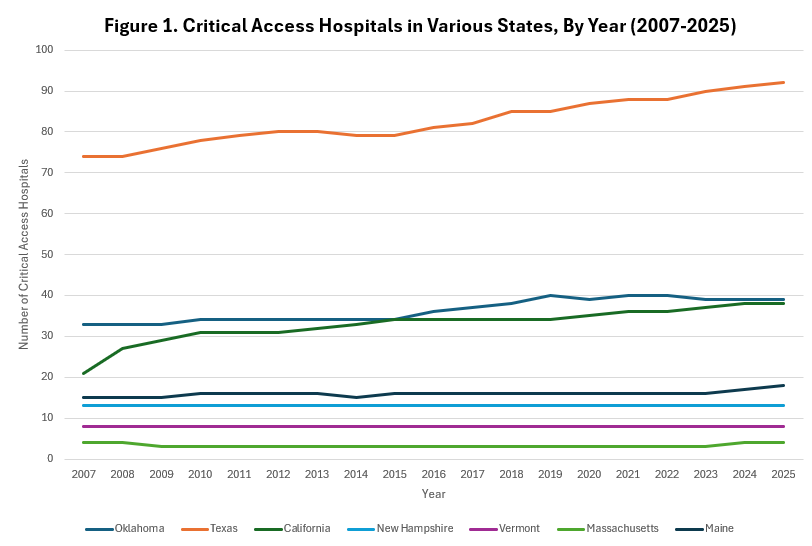
Above: Three states that are associated with the emergence of cash-only ambulatory surgical centers (OK, TX, CA) are compared to New Hampshire and the three other New England states (VT, MA, ME) that have critical access hospitals. The other two New England states (RI, CT) are not shown because they have zero critical access hospitals. Data source: Flex Monitoring Team (a consortium of researchers from the Universities of Minnesota, North Carolina-Chapel Hill, and Southern Maine).
Surgeries do contribute substantially to the viability and financial stability of some CAHs, however not all CAHs provide surgical services.4 And although in one survey, 81% of CAH administrators reported that offering surgeries was "very important" to their hospital's viability, only 12% claimed that their hospital "would close" if they lost the ability to do surgeries altogether.4 It is reasonable to posit that cash-only ASCs might divert some elective outpatient surgical cases from CAHs, potentially reducing incremental revenue from these services. However, this phenomenon has not been quantified at scale, and any impact is likely marginal relative to the broader operational and strategic challenges faced by CAHs.
A likely reason for this is because the financial ecosystems of CAHs and cash-only ASCs differ so markedly. CAHs benefit from cost-based Medicare reimbursement and often operate with thin margins supported by federal subsidies.5 CAHs have a backstop, whereas cash-only ASCs succeed or fail on their own. Because cash-only ASCs depend on upfront payment, they are in many cases competing for a different type of customer altogether when it comes to ability and willingness to pay out-of-pocket, and are not typical Medicare and Medicaid patients.
Instead of thinking of cash-only ASCs as functioning solely as competitors in a zero-sum world of fixed healthcare capacity, cash-only ASCs can be thought of as positive contributors to healthcare service abundance, providing care to a particular segment of the market, and helping to control costs by practicing radical price transparency.
In summary, the concern that cash-only ambulatory surgical centers are causing critical access hospitals to go out of business is not well-supported. Further research could help to quantify effects. Until then, while cash-only ASCs may capture a subset of elective outpatient surgical volume, this displacement effect appears both limited in scope and insufficient to explain CAH financial distress or closures, which are likely driven by more significant systemic factors. Efforts to block the opening of new cash-only ASCs lack good justification.
References:
1. Centers for Medicare & Medicaid Services. "Critical Access Hospitals." CMS.gov. Accessed October 5, 2025.
2. Mehrotra, A., et al. "Comparing Costs and Quality of Ambulatory Surgery Centers and Hospital Outpatient Departments." JAMA. 2009.
3. Cromwell, J., & Mitchell, J.M. "The Impact of Ambulatory Surgical Centers on Hospitals." Health Services Research. 2016.
4. Hoskins, et al. "The Value Surgical Services Bring to Critical Access Hospitals." Cureus. 2021 Apr 8;13(4):e14367.
5. Medicare Payment Advisory Commission (MedPAC). Report to Congress: Medicare and the Health Care Delivery System. 2022.