Remarks on Foreign-Trained Physicians: Testimony on Vermont S 142
Qualified foreign-trained physicians ought to be able to practice medicine without being required to repeat their residency training.
View/Download [PDF]
Rhoads, J. "Remarks on Foreign-Trained Physicians: Testimony on Vermont S 142" Center for Modern Health. February 2026.
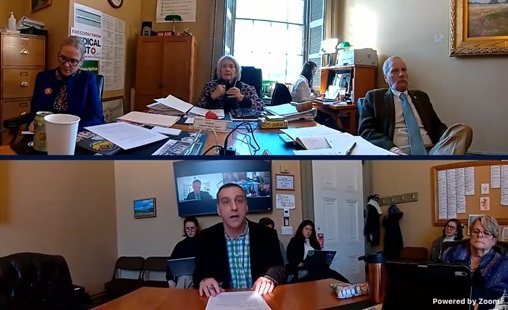
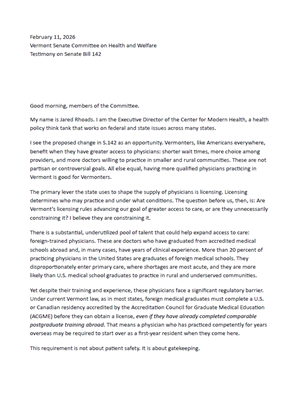
Note: The Center for Modern Health recently testified before the Vermont Senate Health and Welfare Committee regarding Senate Bill 142. The bill would create a pathway for foreign-trained physicians to become licensed to practice medicine without being required to repeat their residency training. Below is the text of our prepared remarks. You can also view the text of the bill and watch the video of the testimony.
Good morning, members of the Committee.
My name is Jared Rhoads. I am the Executive Director of the Center for Modern Health, a health policy think tank that works on federal and state issues across many states.
I see the proposed change in S.142 as an opportunity. Vermonters, like Americans everywhere, benefit when they have greater access to physicians: shorter wait times, more choice among providers, and more doctors willing to practice in smaller and rural communities. These are not partisan or controversial goals. All else equal, having more qualified physicians practicing in Vermont is good for Vermonters.
The primary lever the state uses to shape the supply of physicians is licensing. Licensing determines who may practice and under what conditions. The question before us, then, is: Are Vermont’s licensing rules advancing our goal of greater access to care, or are they unnecessarily constraining it? I believe they are constraining it.
There is a substantial, underutilized pool of talent that could help expand access to care: foreign-trained physicians. These are doctors who have graduated from accredited medical schools abroad and, in many cases, have years of clinical experience. More than 20 percent of practicing physicians in the United States are graduates of foreign medical schools. They disproportionately enter primary care, where shortages are most acute, and they are more likely than U.S. medical school graduates to practice in rural and underserved communities.
Yet despite their training and experience, these physicians face a significant regulatory barrier. Under current Vermont law, as in most states, foreign medical graduates must complete a U.S. or Canadian residency accredited by the Accreditation Council for Graduate Medical Education (ACGME) before they can obtain a license, even if they have already completed comparable postgraduate training abroad. That means a physician who has practiced competently for years overseas may be required to start over as a first-year resident when they come here.
This requirement is not about patient safety. It is about gatekeeping.
Requiring foreign-trained physicians to repeat years of residency training underutilizes their skills. Some, understandably, don’t want to repeat this training and are pushed out of medicine altogether. They could be practicing here, serving Vermonters, if it weren’t for this barrier.
S.142 offers a moral and practical solution. It creates a structured alternative pathway that allows internationally trained physicians—who meet rigorous testing, verification, and competency standards—to enter supervised practice without repeating an entire residency program. Patient safety is maintained through competency assessment and supervision. What changes is that qualified doctors can begin serving Vermonters years sooner.
Several states have already passed legislation allowing experienced foreign-trained physicians to work under provisional or limited licenses while meeting defined competency standards. These models demonstrate that reform is achievable.
The general case for reform is attractive in three ways:
First, the health argument. More physicians means greater access to care, shorter wait times, and better health outcomes—particularly in primary care and in rural communities that have struggled for years to attract providers. This bill directly addresses a real and growing need.
Second, the economic argument. Occupational licensing exists, in theory, to protect the public from unqualified practitioners. But redundant training requirements are a waste of resources. Every year a qualified doctor spends re-doing training is a year that he or she is not seeing patients, not contributing to the local economy, and not generating tax revenue. Reforming this part of the state’s medical licensing rules allows human capital to flow to its highest-value use. It also improves competition in the healthcare market, which benefits consumers.
Third, the moral argument. Individuals who have demonstrated their qualifications deserve the freedom to practice their profession. Vermonters deserve the freedom to choose their own doctors from a wider pool of qualified providers. These medical professionals have chosen to build their lives and careers here. Vermont should welcome their contribution.
S.142 represents sound policy: it addresses a real workforce shortage, removes an unnecessary barrier to practice, respects the qualifications of trained professionals, and expands healthcare access for Vermonters.
That said, in its current form, S.142 requires internationally trained physicians to secure a supervising facility agreement and meet both experience thresholds and examination benchmarks before advancing toward full licensure. While these safeguards are sensible in principle, they could have the unintended effect of creating new barriers, particularly in rural areas where participating facilities are scarce or where otherwise competent physicians have not yet secured employment. As the committee debates this generally good bill, there may be ways to make it even better by ensuring that supervision and facility requirements facilitate rather than frustrate the welcoming of qualified doctors.
Thank you for your time.
Jared Rhoads