One Man's Junk is Another Man's Treasured Health Insurance
And Insurance Mandates Protect the Junk

View/Download [PDF]
Smith, Colleen. "One Man's Junk is Another Man's Treasured Health Insurance" Center for Modern Health. August 2026.
Dr. Oz and the GOP have recently pushed through high-deductible health plans (HDHPs) in an effort to dampen Americans' sticker shock at rising Affordable Care Act (ACA) insurance premiums compounded by the loss of premium subsidies for many middle-class households. These plans allow health savings accounts (HSAs) and remain ACA-compliant by including the set of ten required essential health benefits (EHBs).1
Critics of the HDHPs, such as Bernie Sanders, have been calling these plans junk insurance. To make the point that ACA plans cannot be junk insurance, critics of the critics set out to list a variety of other plans that they deem to be junk insurance.
The used car that I bought in high school in Florida, with a rust hole in the back floor and busted air conditioning, would have been considered junk by many. To me, it was a lifeline to independence and allowed me to earn the money I saved for college.
Why would health insurance be any different? What's junk for one person might be gold for another.
Depending on who's trying to scare you into not buying a certain plan, the list of junk health insurance products is long. But all of these products fit into four buckets:
- Not insurance at all
- Limited health insurance that comes with caveats
- Health insurance that conforms to the ACA's 10 EHBs
- Health insurance that is junk because it's a bad product
1. Not Insurance At All
In some cases, the product on offer isn't insurance at all. And since it's not insurance, we shouldn't call it that. And if the thing tries to call itself insurance, that should be considered fraud. Clearly your direct primary care subscription won't pay your hospital bill at a completely different facility. That doesn't make a direct primary care membership junk; it's just not health insurance. Similarly, your GoodRx discount card probably won't provide enough of a discount on chemotherapy to make that bill affordable.
2. Limited Health Insurance that Comes with Caveats
In some cases, such as HealthCare Sharing Ministries (HCSM) and Farm Bureau Health plans, there is a risk that the group will choose not to pay a claim that is either too expensive or doesn't align with the plan's moral vision. Both types of plans exempt patients from ACA individual mandates even though state and federal governments do not consider them health insurance. This intermediate position allows these plans to avoid strict compliance with the ACA's 10 EHBs. The result is that routine and preventative care might be excluded, or certain pre-existing conditions, or birth control (if it doesn't conform to the religious views of the ministry).
Yet this sort of insurance plan might work well for folks who can afford birth control on their own dime or don't plan to use birth control at all, but can't afford all of the care associated with a heart attack. For others, these plans might be really super turbo junk, and the risk of a surprise coverage rejection might not be worth the lower premiums typically associated with HCSM and Farm Bureau plans.
Other types of insurance with various caveats include short-term, limited-duration insurance (STLDI), condition-specific and accident-only plans, or fixed and hospital indemnity plans. These plans are not comprehensive and come with many coverage limitations. But they can be useful when used for their intended purposes. None of them are meant to provide comprehensive coverage, and it would be fraudulent for them to advertise themselves as such.
But we could all imagine a variety of scenarios that would make any of these plans valuable. Have you ever been between jobs? Maybe COBRA2 is too expensive, and while you can afford a month of medications, you know you wouldn't be able to afford a car accident or hospitalization. For a fraction of the cost, you could buy an STLDI plan or fixed indemnity plan that would cover a portion of an unexpected bill. The resulting peace of mind isn't necessarily junk, but as a consumer, you'll want to understand the limits of your purchase. If you expect these plans to be comprehensive, they'll be junk for you.
3. Health Insurance that Conforms to the ACA's Requirements
Supporters of Dr. Oz argue that the ACA's new HDHPs cannot be junk merely because they conform to the EHBs. Detractors argue that these HDHPs will be "catastrophic to Americans' wallets." But just as all the other plans have their place, ACA plans have their own pros and cons as well.
The platinum, gold, and silver ACA plans with lower deductibles and lower out-of-pocket costs are prohibitively expensive for many middle-class individuals and families who do not qualify for premium subsidies. And the slightly less expensive ACA bronze plans, which have high deductibles and allow HSAs to help offset the high out-of-pocket costs, are still extremely expensive for many. These bronze plans can cost a family of four as much as $30,000 a year in some states in premiums alone.
The new HDHPs have much higher deductibles than bronze plans and limit the number of covered primary care visits per year. These plans still fully cover three primary care visits and 100% of in-network preventive services, as those are EHBs.
Regardless of plan level, most of the ACA plans have very limited networks and no out-of-network coverage, which is a major con that limits healthcare options for enrollees.
For a young, healthy person who makes too much to qualify for subsidized premiums, even a bronze ACA-compliant plan might be a tough sell. Who wants to pay $5,000 in premiums when their predictable out-of-pocket healthcare expenses for the year would be less than $1,000 (which they'll have to pay anyway given the $8,000 deductible)? The ACA's exchange plan options might really be junk for this person. But rest assured, all of their (non-existent) pre-existing conditions will be covered as an EHB.
Conversely, there may be patients for whom an expensive plan with a low to moderate deductible that covers chronic and pre-existing conditions is worth the expense—in particular, a person or family with predictably high healthcare expenses.
4. Health Insurance That Is Junk Because It's a Bad Product
And then there are just plain bad deals—actual junk. These junk plans can hide among any of the products discussed.
Moreover, because the ACA attempted to legislate a host of health insurance requirements, it may have actually made it easier for junk plans to exist by protecting them under a false luster of the ACA designation—after all, a plan can meet the 10 EHBs to be ACA-compliant, but misrepresent its network, institute odd prior authorization requirements, require medications be processed through a terrible pharmacy, and still charge a higher premium.3
If two plans charge the same premium but Plan A has lower deductibles, a wider network, better customer service, or a lower prior authorization denial rate, then Plan A is obviously better. But we don't need legislation to address the terrible Plan B. Over time, in a free market, junk options that are truly worse in every way, like Plan B, would fail on their own because they are junktastic. Members will simply abandon the true junk for a better plan. The only thing that could keep such junk around, as many of the really bad ACA plans stick around, is an external force (like the government) trapping patients into only a few options or propping plans up with subsidies.
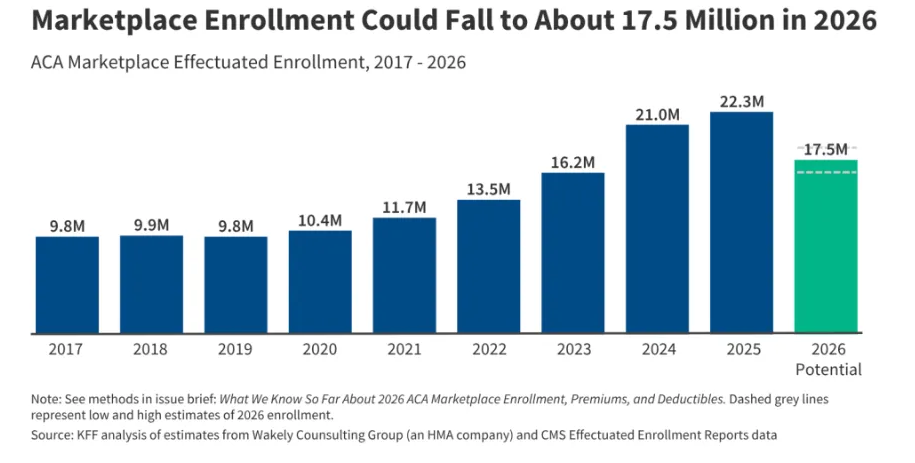
But even here, we see that as more and more people judge ACA plans to be junk to them—simply not worth the expense compared to other ways of financing healthcare—they are dropping those plans and fleeing the marketplace. (See chart below.) Enrollment in ACA plans has dropped in 2026. While there might be a variety of reasons for this, the fact that a higher percentage of ACA plan enrollees are also choosing bronze plans in 2026 indicates that the expense of rising premiums is likely a factor for many.
One man's junk is another man's treasure. That's as true for health insurance products as it is for anything else. Whether a product is valuable and health-enhancing or junk depends on how well its offerings align with the buyer's situational context. As long as a product is not committing fraud, variations in coverage and deductibles in exchange for lower-cost options might be a good deal for many people. The ACA's HDHPs are no different—they could offer value and savings to those with low healthcare expenses but be wholly inadequate for many others. And in a competitive market, true junk—products that are low value for everyone—would simply fail. HDHPs are just another option. And more options mean more opportunity for you to discover the treasure that health insurance can be when it's really needed.
References:
1. Ten essential health benefits (EHBs): ambulatory (outpatient) patient services, emergency services whether the ER is in or out of network, hospitalizations, pregnancy and perinatal care, mental health and substance use disorders, prescription drugs, rehabilitative services, laboratory services, preventive health and chronic disease management must be 100% covered, pediatric services including dental and vision.
2. COBRA stands for Consolidated Omnibus Budget Reconciliation Act, which requires employers to allow former employees to keep their prior employer-sponsored insurance, at the employee's own expense, for a limited time after loss of a job.
3. Honk if you've ever had the misfortune of having chosen a Fidelis plan in NY State.
This article also appears on Dr. Colleen Smith's Substack.
Featured image is "Still Life: Fin and Flowers" by Colleen Smith. Colored Pencil.