States Should Consider Legalizing Overdose Prevention Centers
Overdose prevention centers (OPCs) can save lives and reduce rates of infectious disease in communities.
View/Download [PDF]
Sharma, S. and Rhoads, J. "States Should Consider Legalizing Overdose Prevention Centers" Center for Modern Health. July 2025.
Over 77,000 people died from drug overdose last year in the United States, according to the latest national data from the CDC.1 That is not just a statistic; it represents over two hundred funerals every day. Although the number has come down in the past twelve months, it is still too high, and we could do more to improve the situation. For too long, we have thrown punishment at pain, criminalizing the activities of people who need care. Imagine a town where the river keeps flooding. People drown, and we keep pulling out the bodies. That is what we are doing now with overdoses. What we are not doing is going upstream to stop them from falling in.
Overdose Prevention Centers, or OPCs, are a helpful upstream solution. However, despite growing evidence supporting the public health benefits of OPCs, these facilities remain largely illegal in the United States due to a combination of federal and state legal barriers. At the federal level, the so-called "crack house statute" makes it a felony to knowingly provide or maintain any place for the purpose of using illegal drugs.7 At the state level, drug laws make drug possession illegal in many jurisdictions, and few states have done anything to facilitate the opening of OPCs. Without legal protections, individuals or organizations operating such sites risk prosecution under both state and federal law.
Someone should take the first step forward. Due to preemption, the long-term matter is ultimately in the hands of the federal government. But by passing laws to allow OPCs to open—or at least to allow them to open on a pilot program basis—states could send a strong political signal and establish an implementation framework for when federal enforcement discretion shifts. Such an action also invites legal challenges that can create opportunities to test the boundaries of federal power in court.
For these reasons—and on the grounds of public health effectiveness, cost efficiency, and a moral obligation to prevent preventable deaths—states should take action to legalize overdose prevention centers.
Overdose Prevention Centers Save Lives
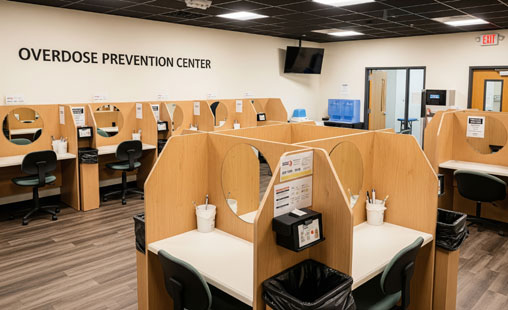
Overdose Prevention Centers are supervised spaces where people use pre-obtained drugs under trained staff. They are designed to prevent deaths, and they work.2 Consider the experience of Canada. In British Columbia, OPCs, called supervised consumption sites, have reversed thousands of overdoses.3 In Vancouver alone, Insite, North America's first OPC, has operated for over 20 years and recorded zero deaths on site. During the fentanyl crisis, these sites were essential in flattening the overdose curve.3 In 2021, New York City followed suit, allowing two OPCs to open in the city, and reversed over 600 overdoses in just one year.
OPCs are a strategy whose effectiveness is not just limited to urban areas, either. Rural regions potentially stand to benefit, too. In 2022, West Virginia had the highest overdose death rate in the United States. Over 80 deaths per 100,000, nearly three times the national average.2 In rural West Virginia, where ambulances can take over 15 minutes to reach patients, access to an OPC could be the difference between a person dying alone or getting a second chance.
Legalizing OPCs would not just add a tool to the toolkit. It would send a clear message that we care more about saving lives than upholding stigma.2,3 Privately funded OPCs would directly counter the harm caused by policies such as SB 334, and help alleviate the challenges that public health experts face.4
OPCs Build a Bridge to Recovery
OPCs do not just prevent death. They create opportunities for connection and the start of recovery. These centers offer nonjudgmental contact with healthcare workers, mental health counselors, and peer recovery coaches.
Many people who use drugs avoid hospitals out of fear, shame, or past trauma. OPCs bring healthcare to them, on their terms.3 And evidence shows that OPCs work. A 2023 study from Vancouver found that people who regularly used OPCs were significantly more likely to start opioid agonist therapy and enter treatment within six months.3 When the door to recovery is always closed, we should not be surprised people do not walk through it. OPCs open that door.
Overcoming Common Objections
One common misconception about OPCs is that OPCs provide the drugs that people use. In reality, OPCs do not provide drugs. Rather, they provide a supervised, sterile space to prevent death and offer immediate access to treatment, referrals, and recovery support.
Another objection to legalizing OPCs is that OPCs might bring more drug users into the area, increase drug dealing nearby, lead to loitering, or strain law enforcement resources. These fears, while they would be understandable if true, are not supported by empirical evidence. A growing body of research suggests that OPCs do not increase crime, and may even reduce certain types of public disorder. For instance, a recent study published in JAMA examined New York City's first two sanctioned city-serving OPCs and found no significant increase in crimes such as drug possession, drug sales, or violent offenses in the surrounding areas after the sites opened.5
Conclusion
American families are drowning in grief. Parents are burying children. Communities are numbed by loss. And yet, we have tools that work but we refuse to use them. OPCs are not silver bullets, but they are lifeboats in a flood. They reduce death, improve community safety, and offer a path forward. If we choose to do nothing, people will keep dying—not because we did not know what to do, but because we were reluctant to act.
References:
1. "Provisional Drug Overdose Death Counts" CDC National Center for Health Statistics. Accessed June 21, 2025.
2. American Civil Liberties Union. "More than 300 West Virginia health care professionals, advocates urge gov. justice to veto Senate Bill 334" May 19, 2021.
3. "Overdose Prevention Centers" National Institutes of Health. June 28, 2024.
4. Peace, L. "Judge rules in favor of law restricting WV needle exchanges" Mountain State Spotlight. July 15, 2021.
5. Chalfin A, del Pozo B, Mitre-Becerril D. "Overdose Prevention Centers, Crime, and Disorder in New York City." JAMA Netw Open. 2023;6(11):e2342228. doi:10.1001/jamanetworkopen.2023.42228
6. Withrow, T. "Harm reduction under attack in West Virginia" West Virginia Watch. February 9, 2024.
7. Singer, J. "Overdose Prevention Centers: A Successful Strategy for Preventing Death and Disease" Cato Institute. February 28, 2023.