Medicare for All Is Wrong, Not Merely Too Expensive
Opponents of Medicare for All should argue that it violates individual rights and freedom, not just that it costs too much.
View/Download [PDF]
Rhoads, J. "Medicare for All Is Wrong, Not Merely Too Expensive" Center for Modern Health. November 2026.
Now that the midterm elections have given them control of the House and the Senate, Democrats will no doubt rediscover health reform as a political priority. In a recent Axios/Ipsos poll, 69 percent of Americans said they were concerned about rising healthcare costs, and nearly 43 percent expressed support for Medicare for All. Worry and frustration are powerful motivators for change.
Republicans often object that Medicare for All would cost trillions, require large tax increases, and disrupt coverage and care for millions of people. Those points are valid and must be made, but they are not sufficient. If opponents of Medicare for All argue only that the plan costs too much, raises taxes, or would be disruptive, they leave the door open for people to think that maybe supporters of the plan are right about the basic idea of government-guaranteed and government-delivered care but have merely put forth a clunky or inefficient way to implement it. This could make it appear as though it’s just implementation details that need to be ironed out.
But it’s not just the details. The whole foundational idea of Medicare for All is wrong, as in morally wrong. Opponents need to make this point more clearly and more consistently.
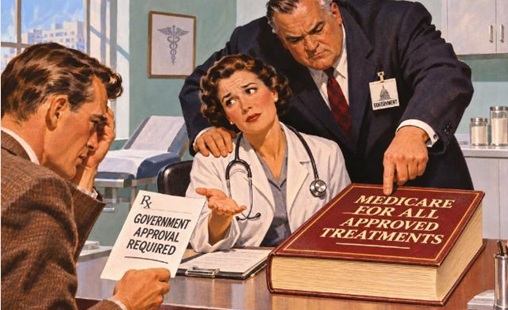
Medicare for All would replace private health insurance with a compulsory system. It does not merely simplify a fragmented system or expand “coverage” to more people. It seizes control over an enormous share of the resources that individuals earn, save, and invest. It makes people pay for strangers' medical expenses by force. And eventually it must decide what counts as healthcare and which innovations qualify.
The consequences for people who work in medicine may be even worse. Physicians and other health professionals have their own lives, judgment, ambitions, and plans. A government monopoly care would dictate the terms on which people can deal with one another. The right ideal isn't the fantasy that everything will be taken care of, somehow. The right ideal is that these participants should be able to make decisions within a system of voluntary exchange, guided by professional standards and their own ideas about how they would like to pursue health. Medicare for All can't possibly leave these decisions to free choice; it would necessarily subject more and more of these decisions to political priorities and bureaucratic rules.
An approach to healthcare that overrides individual rights in this way does not become morally justified merely because its beneficiaries have serious needs. Republicans have no trouble estimating the troubling cost of government-run healthcare or pointing to the unsettling wait times for visits and procedures in other countries with such systems. It's not exactly right to say that those who make such objections concede the moral case. Conceding something generally means to admit that something is true, or to admit defeat. Most Republicans don't do that. Nor exactly do they cede the moral case, which means to formally surrender this point or hand over this policy territory. It's more like they've abandoned or vacated the moral argument, or to put it in courtroom terms, that they've decided to plead "no contest" against single-payer advocates' expressions of righteousness.
Major parts of U.S. healthcare are indeed dysfunctional. Nobody in the policy community gains credibility by disputing that. For those who would like to shift the system toward greater freedom and reliance on markets, designing a realistic strategy for actually getting there is not easy. It may even require some compromise or negotiation.
Popular support for Medicare for All may reflect a genuine desire for government control over healthcare. Or it may simply reflect frustration with a system that is too costly, too complicated, and not free enough. Americans might be just as receptive to a morally confident alternative grounded in freedom and free markets. They deserve to hear that case made clearly and with conviction.
This article originally appeared on American Thinker.