Assessing the Policy Attitudes of State Legislators Toward Overdose Prevention Centers
Understanding state legislator perspectives on harm reduction and OPCs may help inform policy advocacy efforts to prevent overdose, illness, and injury among people who use drugs.

View/Download [PDF]
Sher Gongora, D. and J. Rhoads. "Assessing the Policy Attitudes of State Legislators Toward Overdose Prevention Centers" Center for Modern Health. September 2026.
Abstract
Opioid overdose is the leading cause of death among Americans ages 18 to 45. Historically, New England states have been among the top states nationally for opioid-related overdose deaths. Overdose deaths from opioids like fentanyl are preventable with timely and effective intervention. Overdose prevention centers (OPCs) have been shown to be effective in preventing overdose and other use-related harms, including HIV and hepatitis C spread and underutilization of healthcare services by people who use drugs. However, federal and state laws that prohibit the operation of OPCs are critical barriers to preventing overdose in New England. This policy brief presents preliminary findings collected from New England state legislators (n=35) surveyed on their existing attitudes and beliefs about the overdose crisis and OPCs. Understanding state legislator perspectives on harm reduction and OPCs may help inform policy advocacy efforts to prevent OD, illness, and injury among people who use drugs.
Background
In 2023, over 105,000 people died from a drug overdose (OD) in the United States.1 Approximately 80,000 (76%) of these deaths involved opioids, a tenfold increase from the number of opioid-related overdoses in 1999.2 Today, opioid overdose is the leading cause of death among Americans ages 18 to 45.3 Historically, New England states have been among the top states nationally for opioid overdose deaths, and this is largely due to increases in accidental fentanyl poisoning.4
Overdose Prevention Centers (OPCs) are special places designed to prevent overdose deaths. They are safe settings for people to use pre-obtained drugs under the supervision of trained staff who provide immediate intervention in the event of an overdose or other health emergency. OPCs have also offered safer use equipment, drug checking resources, and linkages to healthcare services, including primary and mental health care, sexual health care, HIV and hepatitis C testing, and wound care.5 Typically, they are run by nonprofit organizations that specialize in harm reduction and connecting people with health services.
OPCs are a matter of public policy because they exist at the intersection of public health and criminal law. Due to federal and state laws that classify providing a space for illegal drug use as a felony,6 an organization cannot simply decide to open up and run an OPC on its own. It needs special permission from the state. As of early 2026, there are three recognized OPCs currently operating in the United States: two in New York City and one in Providence, Rhode Island.7 However, policies such as drug paraphernalia laws and operational restrictions remain crucial barriers to OPC implementation across the country.8 We sought an opportunity to explore how policymaker attitudes and beliefs relate to OPC lawmaking.
In Vermont, legislation has moved forward to support OPC implementation, whereas other New England states have not yet sanctioned them at the state level.9 Despite these varying policy positions, New England is a region ripe for harm reduction policy development, and understanding the root of OPC hesitancy among New England legislators may help inform focused advocacy and research.
This exploratory study utilized a direct survey to identify commonly reported attitudes and beliefs about OPCs among New England state legislators. Three key preliminary findings from the study are explored in this brief report. Further findings will be shared in a subsequent publication.
#1. Community opposition was the most frequently reported barrier to establishing an OPC
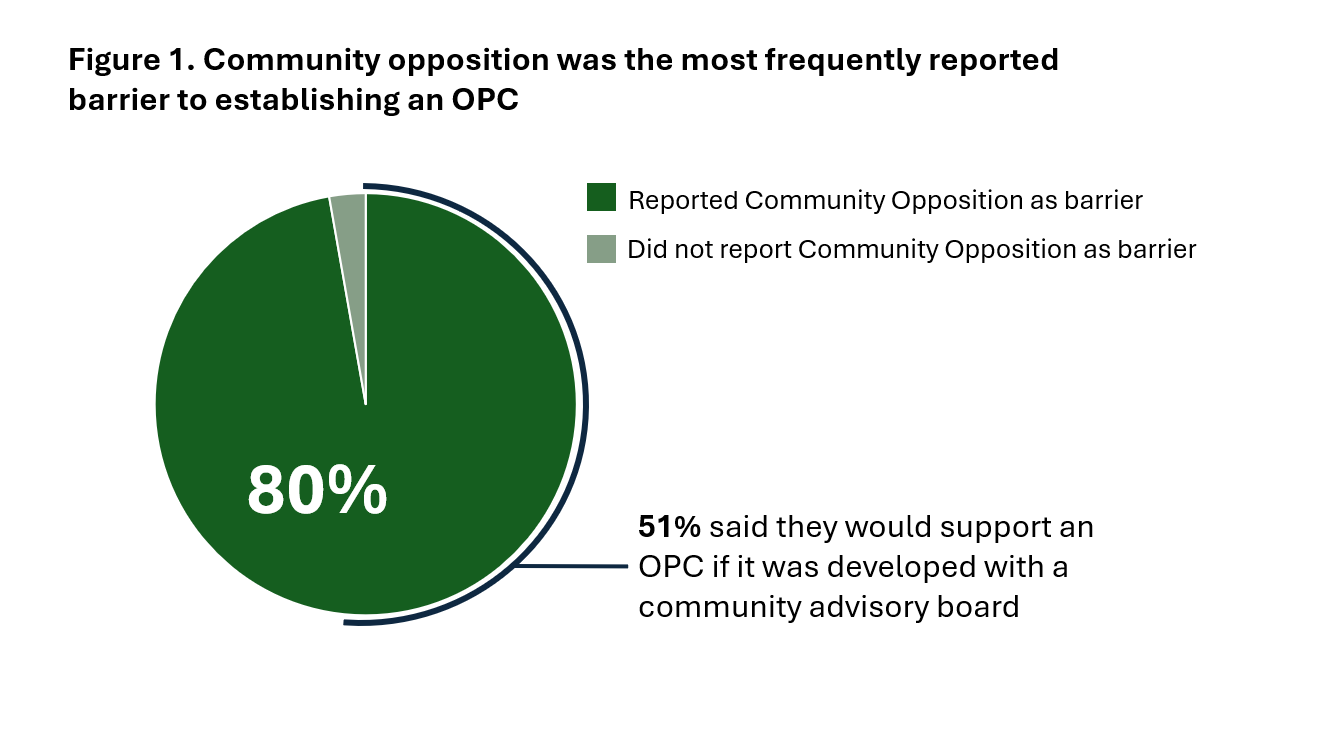
Community opposition is a known barrier to establishing harm reduction programs like OPCs around the country,8,10 and one that is likely experienced to greater degrees by legislators who depend on community support for re-election and effective policy implementation.11 With 80% of respondents reporting community opposition as a barrier to OPC implementation in their state, it was the most frequently reported across states and offices (Figure 1). Researchers and activists alike have attributed community opposition to harm reduction programs to stigma, or the set of negative beliefs and attitudes that some people hold about people who use drugs.12–14 Community opposition and stigma are critical barriers to OPC implementation as policymakers often use public support data to inform policy action, and low rankings or opposing constituent opinions can halt implementation for many election cycles.11 Key to understanding stigma as it relates to OPC implementation is the phenomenon of NIMBY-ism. NIMBY, standing for Not In My Backyard, encompasses neighborhood-level opposition to building new programs despite conceptual agreement that the services may be needed.10 This form of stigma has been seen consistently across harm reduction program implementation, with community members verbalizing theoretical support while opposing the development of these programs in their area.8,10,15
Opposition to OPCs is often rooted in concerns that are reasonable but may be misinformed. Fears about increased public injection, crime, and homelessness are commonly cited reasons for resistance but have not been shown to be significantly related with OPC operation.16,17
Notably, 51% of respondents indicated that one necessary condition for their support of OPC implementation is the center being developed with input from a community or client advisory board. Community Advisory Boards (CABs) are a cornerstone of harm reduction development and evaluation and are often composed of people with lived experience, healthcare workers and clinicians, business owners, and community members.18 CABs are an evidence-based way of ensuring harm reduction programs meet the unique needs of the neighborhoods they serve, and may be a key method of dissolving community opposition. When community members are given the opportunity to provide input that shapes program implementation, they are more likely to support operation of novel programs and research efforts.19 This is especially true when CABs are composed of different stakeholder groups, ranging from people who use drugs (PWUD) themselves to clinicians and researchers. Studies have shown that personal anecdotes and scientific research are both viable tools to garner support for harm reduction programs,20 and CAB efforts are prime opportunities for those opposed to OPCs to interact with both. Importantly, CABs are also important vessels for translating novel programming into policy-oriented language. If CABs and program development teams are equipped with the tools to translate the program’s progress into digestible findings, this data has the potential to be crucial drivers of community support, and thus, policy action.11
#2. Legislators who felt their state was not doing enough to prevent overdose were more likely to support OPCs
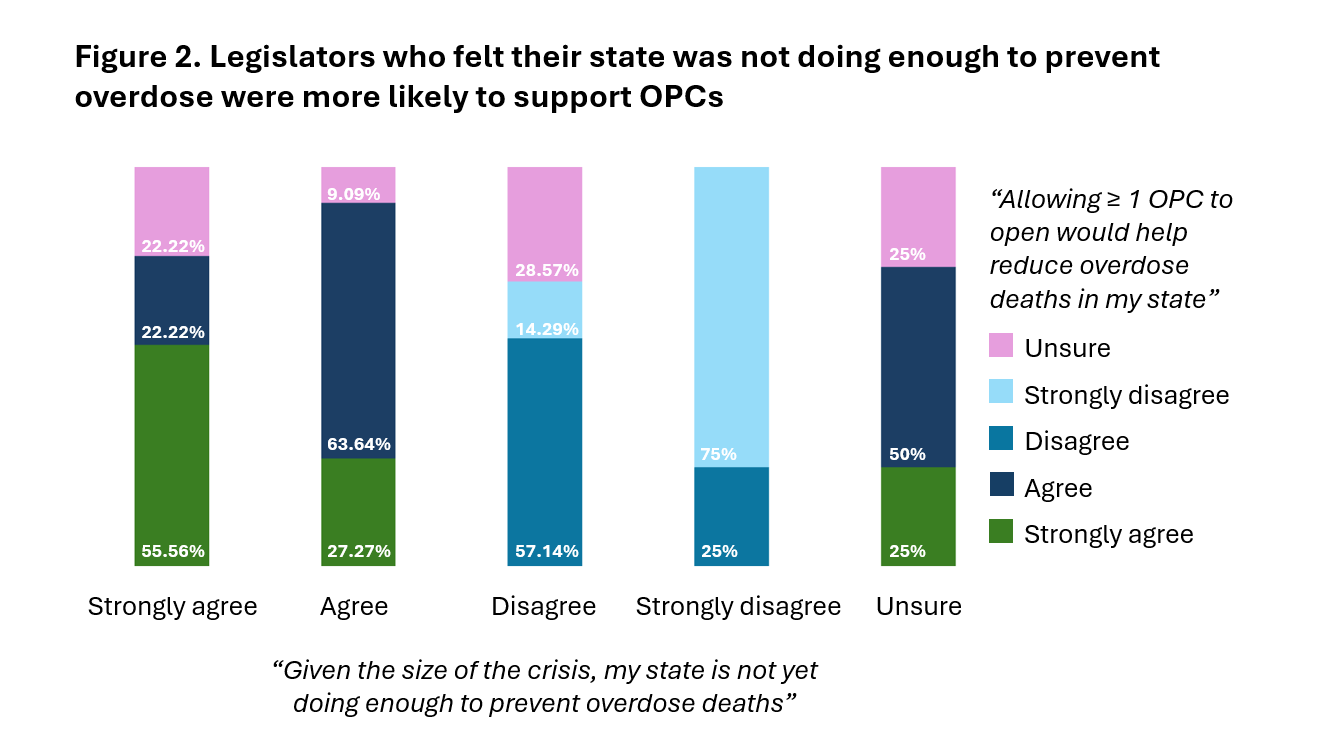
This exploratory finding addresses a classic public health question: does greater familiarity with an issue correlate with greater support for an intervention? Across harm reduction programming, studies have found that increased education and knowledge of the overdose crisis and evidence for overdose prevention initiatives are associated with improved attitudes towards harm reduction.21,22 Similarly, multiple studies have found that increased understanding of the mechanisms by which harm reduction programming works (i.e., naloxone to reverse overdose and syringe exchange programs to prevent disease spread) was also associated with increased support for harm reduction after education.23 Among this sample, legislators who felt that their state was not yet doing enough to prevent overdose were more likely to support OPC implementation in their state (Figure 2). Among legislators who disagreed, support for OPCs was nonexistent, and 75% of these respondents directly opposed OPC implementation.
While New England states have made significant progress in reducing overdose, there remain widespread and pervasive care gaps that sustain high mortality rates, especially among at-risk communities. Many involved in harm reduction initiatives located in this region would agree that, despite overall advances, the six New England states still struggle to overcome barriers to overdose prevention, including increasing access to reversal medicine, medication-assisted treatments, and drug testing equipment. Historically, parts of New England have been among the top states nationally for opioid overdose deaths, and New Hampshire and Massachusetts ranked the 1st and 3rd for the highest fatal fentanyl overdose rates in 2016.4,24 It is difficult to parse whether responses from dissenting legislators (those who disagreed with the statement that their state was not doing enough) can be attributed to genuine knowledge gaps about the scope of the crisis or to a fundamental opposition to addressing it, but it highlights a potential area for focused messaging.
For those who are unfamiliar with overdose burden in their state, educational proposals that frame OPCs as tools in the greater fight against premature death and illness may be a successful approach among policymakers.25 Overall, this finding supports previous research that urges harm reduction advocates to increase education about the burden of the overdose crisis and the gaps that OPCs may help fill, with special attention given to their care linkage services, infectious disease prevention, and poisoning response.8,25
#3. Over half of respondents reported political risk or potential opposition as a barrier to establishing an OPC
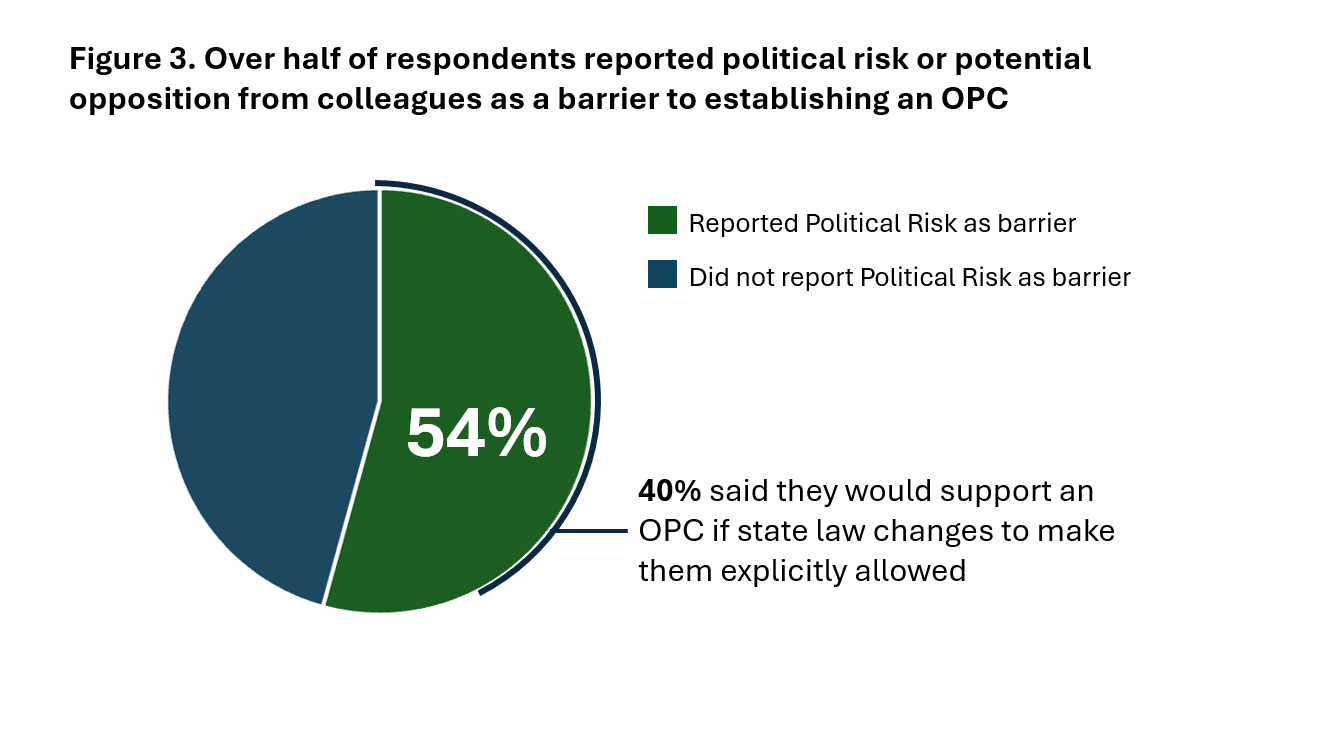
Many harm reduction programs were not popular when first introduced. However, with evidence, time, and advocacy, initiatives like naloxone distribution and syringe exchange programs garnered political support at the state and federal levels. Research has endeavored to identify the motivators behind legislative decisions on novel or controversial policies and have consistently identified political risk (that is, becoming unpopular among voters) and political opposition as heavily weighted factors. Among this sample, 54% of respondents indicated political risk and opposition from colleagues as some of the biggest barriers to OPC implementation in their state. As has been noted in New England, when policies are predicted to be disliked, policymakers are less likely to advocate for them or are more likely to propose "watered-down" versions to increase appeal.26 This is because the goal of policymakers is often to obtain popular support that facilitates cooperation and sustained, effective policy action.11,27
Research conducted on OPCs throughout global history (both observational and modeling studies) has established an association with reductions in overdose and the behaviors associated with infectious disease spread and increased linkages to healthcare.7 In light of these successes, understanding its unpopularity with many American voters, and thus American legislators, requires deeper digging into the impact of stigma and language framing when discussing programming that does not center on abstinence.28,29
Historically, federal US policy approaches to addressing substance use and the overdose crisis have centered on abstinence and no-tolerance enforcement of laws like the Controlled Substances Act (CSA).30 The CSA provides a legal framework for drug regulation and is mirrored in many state-level drug policies, sometimes with modifications.6 Importantly, the CSA prohibits organization of any place for the purpose of acquiring and using controlled substances, a statute which many have interpreted to include OPCs.7 However, state legislators have the power to sanction an OPC at the state-level under the Tenth Amendment, as has been done in Rhode Island and is in-process in Vermont through state authorization of OPC pilot programs.7,31,32 40% of respondents indicated that changes to state laws that make OPCs explicitly allowed would be a condition under which they would consider supporting its implementation (Figure 3). This relationship between state law changes, public support, and policymaker action occur in a complex cycle with many points of entry. These changes to state law would be more likely to occur if constituents voice support for OPCs and advocate for reformed CSA policy. However, public opinion polling has indicated that when state law changes first, public support follows; when OPCs are framed within state-regulated public health strategies, community support for them increases.33 Thus, if state law is modified to allow for operation of OPCs, whether through explicit permission or loosening of federal law enforcement, popular support is projected to increase. In turn, this community support exerts pressure on all legislative officials to drive OPC-supportive policy, minimizing political risk from voters and colleagues.33 This policy action cycle in harm reduction decision making warrants further study.
Methods and Participants
This exploratory study surveyed New England legislators from New Hampshire (n=21), Maine (n=6), Connecticut (n=5), Massachusetts (n=2), and unknown (n=1). Most respondents were state Representatives (n=31) and the remaining were state Senators (n=3) or preferred not to say (n=1). Thirty-five complete responses were obtained between March and April 2026, with a response rate of about 3.5% from the 987 eligible legislators (or several percentage points higher if out-of-office replies are subtracted out of the denominator). This response rate is lower than previous research surveying state policymakers about healthcare generally,34,35 but is comparable to similar studies exploring state legislators’ attitudes about public health-focused policy via email-only survey.36 The surveys were administered via Qualtrics and all participants were contacted via email three times using both Center for Modern Health and Dartmouth College email addresses. The complete questionnaire and a comprehensive response dataset will be made available following further analysis.
Conclusion
This exploratory study offers a preliminary look at New England legislators' attitudes toward overdose prevention centers, identifying community opposition, political risk, and perceptions of the overdose crisis as important factors shaping support. The findings suggest that community engagement, education, and attention to local legal and political barriers may help inform future policy efforts. Given the low response rate, further work is needed to explore ways of measuring legislator opinions outside the context of reviewing public votes and public statements, and more research is needed to determine whether these attitudes reported here reflect broader legislative perspectives.
References:
1. National Institute on Drug Abuse. Drug Overdose Deaths: Facts and Figures. 2024. Accessed September 11, 2026. NIDA. 2024, August 21. Drug Overdose Deaths: Facts and Figures . Retrieved from https://nida.nih.gov/research-topics/trends-statistics/overdose-death-rates on 2026, September 3
2. Understanding the Opioid Overdose Epidemic. Centers for Disease Control and Prevention; 2026. Accessed September 11, 2026. https://www.cdc.gov/overdose-prevention/about/understanding-the-opioid-overdose-epidemic.html
3. DEA Administrator on Record Fentanyl Overdose Deaths. getsmartaboutdrugs.org. https://www.getsmartaboutdrugs.gov/media/dea-administrator-record-fentanyl-overdose-deaths
4. Drug Enforcement Administration. Fentanyl Remains the Most Significant Synthetic Opioid Threat and Poses the Greatest Threat to the Opioid User Market in the United States. Published online May 2018.
5. Dunham K, Hill K, Kazal H, et al. In Support of Overdose Prevention Centers: Position Statement of AMERSA, Inc (Association for Multidisciplinary Education and Research in Substance Use and Addiction). Subst Use Amp Addict J. 2024;45(3):328-336. doi:10.1177/29767342241252590
6. Lampe JR. The Controlled Substances Act (CSA): A Legal Overview for the 119th Congress. Congressional Research Service; 2025.
7. Pridgen BE, Bontemps AP, Lloyd AR, et al. U.S. substance use harm reduction efforts: a review of the current state of policy, policy barriers, and recommendations. Harm Reduct J. 2025;22(1):101. doi:10.1186/s12954-025-01238-4
8. Rosen JG, Thompson E, Tardif J, Collins AB, Marshall BDL, Park JN. "Make yourself un-NIMBY-able": stakeholder perspectives on strategies to mobilize public and political support for overdose prevention centers in the United States of America. Harm Reduct J. 2024;21(1):40. doi:10.1186/s12954-024-00955-6
9. ACLU of New Hampshire. Public Safety in Manchester: A Community Assessment. Published online April 2024. Accessed September 11, 2026. https://www.aclu-nh.org/app/uploads/2024/04/manchestercna_2024.pdf
10. Koehm K, Rosen JG, Yedinak Gray JL, Tardif J, Thompson E, Park JN. "Politics Versus Policy": Qualitative Insights on Stigma and Overdose Prevention Center Policymaking in the United States. Subst Use Addict J. 2024;45(4):682-689. doi:10.1177/29767342241253663
11. Brownson RC, Royer C, Ewing R, McBride TD. Researchers and Policymakers: Travelers in Parallel Universes. Am J Prev Med. 2006;30(2):164-172. doi:10.1016/j.amepre.2005.10.004
12. National Institute on Drug Abuse. Stigma and Discrimination. June 7, 2022. Accessed August 24, 2026. https://nida.nih.gov/research-topics/stigma-discrimination
13. Akiba CF, Megerian CE, Chung EO, et al. The role of stigma in impeding implementation of harm reduction services in San Francisco. SSM - Qual Res Health. 2025;8:100593. doi:10.1016/j.ssmqr.2025.100593
14. Kennedy-Hendricks A, Barry CL, Gollust SE, Ensminger ME, Chisolm MS, McGinty EE. Social Stigma Toward Persons With Prescription Opioid Use Disorder: Associations With Public Support for Punitive and Public Health–Oriented Policies. Psychiatr Serv. 2017;68(5):462-469. doi:10.1176/appi.ps.201600056
15. Rouhani S, Schneider KE, Weicker N, Whaley S, Morris M, Sherman SG. NIMBYism and Harm Reduction Programs: Results from Baltimore City. J Urban Health. 2022;99(4):717-722. doi:10.1007/s11524-022-00641-7
16. Potier C, Laprévote V, Dubois-Arber F, Cottencin O, Rolland B. Supervised injection services: What has been demonstrated? A systematic literature review. Drug Alcohol Depend. 2014;145:48-68. doi:10.1016/j.drugalcdep.2014.10.012
17. Chalfin A, Del Pozo B, Mitre-Becerril D. Overdose Prevention Centers, Crime, and Disorder in New York City. JAMA Netw Open. 2023;6(11):e2342228. doi:10.1001/jamanetworkopen.2023.42228
18. Kapler S, Hassan H, Jeremiah A, et al. Establishing a community advisory board to align harm reduction research with the unique needs of Black and Latine communities. Harm Reduct J. 2025;22(S1):74. doi:10.1186/s12954-025-01214-y
19. Matthews AK, Anderson EE, Willis M, Castillo A, Choure W. A Community Engagement Advisory Board as a strategy to improve research engagement and build institutional capacity for community-engaged research. J Clin Transl Sci. 2018;2(2):66-72. doi:10.1017/cts.2018.14
20. Grisamore SP, DeMatteo D. Overcoming stigma: Community support for overdose prevention sites. Int J Drug Policy. 2024;127:104415. doi:10.1016/j.drugpo.2024.104415
21. Razaghizad A, Windle SB, Filion KB, et al. The Effect of Overdose Education and Naloxone Distribution: An Umbrella Review of Systematic Reviews. Am J Public Health. 2021;111(8):e1-e12. doi:10.2105/AJPH.2021.306306
22. Haegerich TM, Jones CM, Cote PO, Robinson A, Ross L. Evidence for state, community and systems-level prevention strategies to address the opioid crisis. Drug Alcohol Depend. 2019;204:107563. doi:10.1016/j.drugalcdep.2019.107563
23. Strickland JC, Victor G, Ray B. Perception of Resource Allocations to Address the Opioid Epidemic. J Addict Med. 2022;16(5):563-569. doi:10.1097/ADM.0000000000000971
24. Stopka TJ, Jacque E, Kelso P, et al. The opioid epidemic in rural northern New England: An approach to epidemiologic, policy, and legal surveillance. Prev Med. 2019;128:105740. doi:10.1016/j.ypmed.2019.05.028
25. White SA, Lee R, Kennedy-Hendricks A, Sherman SG, McGinty EE. Perspectives of U.S. harm reduction advocates on persuasive message strategies. Harm Reduct J. 2023;20(1):112. doi:10.1186/s12954-023-00849-z
26. Popp E. Progressive legislators not seeking reelection say institutional barriers often prevent change. Maine Beacon. Accessed August 26, 2026. https://mainebeacon.com/progressive-legislators-not-seeking-reelection-say-institutional-barriers-often-prevent-change/
27. Choi BCK, Pang T, Lin V, et al. Can scientists and policy makers work together? J Epidemiol Community Health. 2005;59(8):632-637. doi:10.1136/jech.2004.031765
28. Barry CL, Sherman SG, Stone E, et al. Arguments supporting and opposing legalization of safe consumption sites in the U.S. Int J Drug Policy. 2019;63:18-22. doi:10.1016/j.drugpo.2018.10.008
29. Barry CL, Sherman SG, McGinty EE. Language Matters in Combatting the Opioid Epidemic: Safe Consumption Sites Versus Overdose Prevention Sites. Am J Public Health. 2018;108(9):1157-1159. doi:10.2105/AJPH.2018.304588
30. Lofaro RJ, Miller HT. Narrative Politics in Policy Discourse: The Debate Over Safe Injection Sites in Philadelphia, Pennsylvania. Contemp Drug Probl. 2021;48(1):75-95. doi:10.1177/0091450921993821
31. Beletsky L, Davis CS, Anderson E, Burris S. The Law (and Politics) of Safe Injection Facilities in the United States. Am J Public Health. 2008;98(2):231-237. doi:10.2105/AJPH.2006.103747
32. D’Auria P. Lawmakers override Phil Scott’s veto of overdose prevention center bill. The VTDigger. June 17, 2024. https://vtdigger.org/2024/06/17/lawmakers-fail-to-override-phil-scotts-veto-of-overdose-prevention-center-bill/
33. Socia KM, Stone R, Palacios WR, Cluverius J. Focus on prevention: The public is more supportive of "overdose prevention sites" than they are of "safe injection facilities." Criminol Public Policy. 2021;20(4):729-754. doi:10.1111/1745-9133.12566
34. Pagel C, Bates DW, Goldmann D, Koller CF. A Way Forward for Bipartisan Health Reform? Democrat and Republican State Legislator Priorities for the Goals of Health Policy. Am J Public Health. 2017;107(10):1601-1603. doi:10.2105/AJPH.2017.304023
35. Purtle J, Dodson EA, Nelson K, Meisel ZF, Brownson RC. Legislators’ Sources of Behavioral Health Research and Preferences for Dissemination: Variations by Political Party. Psychiatr Serv. 2018;69(10):1105-1108. doi:10.1176/appi.ps.201800153
36. Niederdeppe J, Roh S, Dreisbach C. How Narrative Focus and a Statistical Map Shape Health Policy Support Among State Legislators. Health Commun. 2016;31(2):242-255. doi:10.1080/10410236.2014.998913
Photo by Kwanchai Chai-Udom, courtesy Vecteezy.