Paring Down Coverage Mandates To Reduce Health Insurance Premiums
If rising health insurance costs are a concern, state policymakers should reconsider the coverage mandates that force people to buy more coverage than they want.

View/Download [PDF]
Rhoads, J. "Paring Down Coverage Mandates To Reduce Health Insurance Premiums" Center for Modern Health. October 2026.
Long before the federal government instituted its list of required "Essential Health Benefits" in 2014 as part of the Affordable Care Act (ACA), state governments had their required benefits, too. The first such coverage mandate is usually considered to be the 1956 law in Massachusetts that required dependent coverage for handicapped children.1 State coverage mandates gradually expanded in the 1960s and 1970s, with states adding mandates for various conditions, treatments, and provider types (e.g., diabetes, treatment for alcoholism, and chiropractic care). In the 1960s and 1970s, most states had just a few coverage mandates each. Today, the average state has more than 40 coverage mandates on its books, and some states have many more than that.
The "winners" in this situation are the people who obtain and use that benefit essentially at a discount, because with a mandate in place, the cost of that benefit is spread across many more people. The "losers" are all the people who wouldn't have voluntarily purchased a policy that included that coverage benefit had it been up to them to decide. Additionally, coverage mandates tilt the culture of insurance toward comprehensive coverage and away from becoming more personalized by encroaching on the ability of consumers who would prefer to buy slimmer policies from being able to get just the amount of coverage they want.
Coverage mandates also increase the cost of insurance. Proponents of coverage mandates sometimes push back against this claim, arguing that coverage mandates can in theory save money for "the healthcare system as a whole" if having the coverage enables some people to intervene in their own health problems earlier. Some proponents even argue that coverage mandates are good for paternalistic reasons, namely that consumers are either incapable of knowing how much coverage they should buy, or that if they know it, they are unlikely to be responsible enough to follow through and purchase it.2
Measuring exactly how much each coverage mandate contributes to the average premium is complex. Without very granular data, only rough estimates are possible. Still, it is worthwhile to develop some approximate numbers to help policymakers understand roughly how much consumers could save on their insurance premiums if coverage mandates were repealed.
Estimating the Costs of Coverage Mandates
Using an empirical estimate from a 2016 peer-reviewed analysis of state insurance mandates and employer-sponsored health insurance premiums, we have generated a crude estimate of the costs that state coverage mandates contribute to health insurance for nine northeastern states.3 The reference paper, titled "The Effect of Health Insurance Benefit Mandates on Premiums," written by economist James Bailey and published in the Eastern Economic Journal, uses a dataset containing 693 state-year observations between 1996 and 2011 to come up with an estimate of how much the average state insurance mandate increased premiums by. His analysis arrived at an estimate that the average state insurance mandate increased premiums by approximately 0.44 to 1.11 percent, per coverage mandate.
Taking this estimated range and multiplying by the counts of coverage mandates published in the Center for Modern Health's 2026 Health Freedom Index and by the state-specific 2025 employer-sponsored premiums from the Medical Expenditure Panel Survey-Insurance Component (MEPS-IC), we have come up with a simple potential savings calculation for each state.

We calculate the range using the lower estimate of 0.44 percent and the upper estimate of 1.11 percent per mandate, and for simplicity we present two different scenarios: one in which the state repeals five of its coverage mandates, and another in which the state repeals 10 of its coverage mandates. We do this for a contiguous cluster of nine states in the northeastern United States: Connecticut, Maine, Massachusetts, New Hampshire, New Jersey, New York, Pennsylvania, Rhode Island, and Vermont.
Results for Nine States in a Northeast Cluster
The tables below show the calculations for the individual policy market (Table 1) and the family policy market (Table 2). In the individual policy market, for many states, repealing 5 to 10 coverage mandates could correspond to annual premium reductions of between several hundred dollars and in some cases more than a thousand dollars. In the family policy market, repealing 5 to 10 coverage mandates in some cases could save families several thousand dollars. (Note that the premium figures in both tables are total premiums rather than the employee's contribution alone. This is because, regardless of what one calls them, "employer contributions" toward health insurance are ultimately paid by employees. I.e., we subscribe to what might be called the total compensation perspective.)
Table 1. The resulting estimates are shown below for the individual policy market.
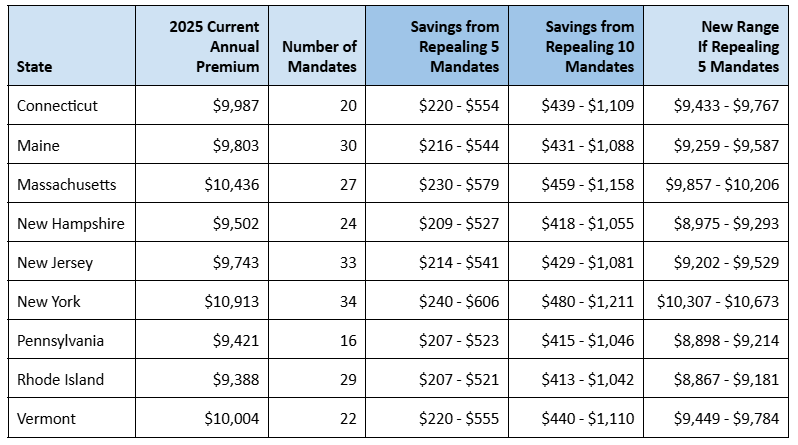
Table 2. The resulting estimates are shown below for the family policy market.
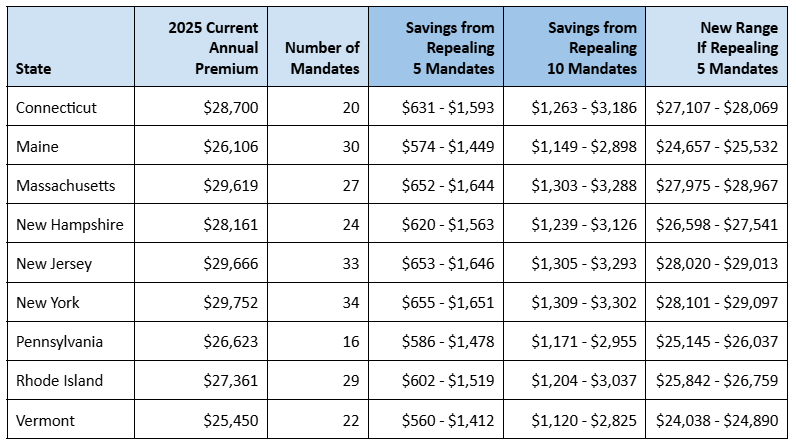
Note: The current annual premium figures are from the MEPS spreadsheets published by AHRQ. On each state's spreadsheet, these are the lines on Table VIII labeled VIII.C.1 and VIII.D.1.
Policy Discussion
No U.S. state has abolished or repealed all of its health insurance coverage mandates, but the number of coverage mandates varies widely. If rising health insurance premiums is a concern, policymakers should question whether maintaining their existing coverage mandates is a wise move. Policymakers need to be reminded that insurance regulation is cumulative. Each new proposed mandate may appear modest when put up for a vote individually. But over time, the accumulation of dozens of mandates can substantially increase the cost of coverage.
Proponents of keeping coverage mandates will ask, "What about the people who use these services; won't their premiums go up under repeal?" That question should be answered with the question: "What about the people who don't use these services; why are they forced to buy more expensive coverage than they want?" The existence of a medical service that someone needs does not by itself establish a case for requiring every insurance policy to cover that service.
Complete repeal of coverage mandates is likely to be politically infeasible, but states can still consider narrower reforms. Creating exemptions and mandate waivers for certain people is an option, but the flattest, fairest approach may be to select some set of the existing mandates and repeal those. That is why in the calculations above we give two scenarios for each state and for each plan type (individual and family): repealing 5 mandates and repealing 10 mandates. Even a modest repeal effort could save citizens a non-trivial amount of money each year.
A final point is that, whether states engage in repeal or not, they should adopt a higher evidentiary standard before enacting new mandates. Any proposed mandate should be evaluated not only in terms of the people who would "benefit" from the change, but also from the perspectives of the people who would prefer a less expensive insurance product but are prevented from purchasing one. Patient advocacy groups can mount emotional campaigns to call for more coverage, but there is no naturally-occurring constituency for the people who do not need a given benefit yet will be asked to share in its cost. Legislators must think about those constituents too.
Limitations
The calculations above should be interpreted as rough guides to aid in the policymaking process, not as econometric forecasts. The purpose of this exercise is to provide policymakers with an order-of-magnitude estimate of the gains that could come from paring back these coverage mandates, given the absence of such estimates in the academic literature.
There are many limitations. For example, Bailey's estimates are based on historical data from 1996 through 2011. If redone with newer data, the coefficients could be lower, or they could be higher. Also, mandates differ substantially in cost. A mandate requiring a relatively inexpensive benefit that was already commonly covered could have little effect, whereas a costly benefit that few consumers would voluntarily purchase could have a much larger effect.
Finally, state mandates do not apply to self-insured employer plans subject to ERISA, so it would not be accurate to say that every single person in a state would save on his or her health insurance. People with self-insured employer plans would not necessarily see any change. Mainstream estimates put the share of private-sector enrollees who are enrolled in self-insured plans at somewhere between 65%-70%, so the coverage mandate repeals that we discuss in this article would only affect about 30%-35% of people with coverage.4
Conclusion
State-mandated health insurance benefits represent a longstanding and consequential form of healthcare regulation. They spread risk out over more people, but they impose costs on those who otherwise would not voluntarily choose to buy certain types of coverage, and they reinforce the notion that insurance should be as comprehensive as possible rather than as parsimonious as possible. State policymakers who are looking for ways to reduce health insurance premiums for their constituents should review their state's existing coverage mandates and consider repeal.
Appendix I. Examples of Coverage Mandates
This appendix provides examples of health insurance coverage mandates currently in effect in the nine states examined in this article. It is not an exhaustive inventory of each state's mandates, but rather a sample to illustrate the range of benefits, services, and treatments that states require health insurance plans to cover. To look up the actual list of coverage mandates for each state, refer to: Information on Essential Health Benefits Benchmark Plans, a resource maintained by the Centers for Medicare and Medicaid Services (CMS). Sample coverage mandates include:
- Obesity & Morbid Obesity/Bariatric Surgery
- Pregnancy, Delivery and Postpartum Coverage
- Accidental ingestion of a controlled drug
- Treatment of medical complications of alcoholism
- Early intervention services (Birth-To-Three Program)
- Infertility treatment
- Coverage For Certain Biologically Based Mental Illnesses
- Coverage For Treatment Of Pervasive Developmental Disorder Or Autism
- Artificial Limb Coverage
- Wound care for individuals with epidermolysis bullosa
- Scalp Hair Prostheses
- Cleft palate
- Coverage for contraceptives
- Hypodermic syringes or needles
- Coverage for Hearing Aids
- Mammography & for Testing for Occult Breast Cancer
- Reconstruction Surgery as a Result of Mastectomy
- Diabetes - Diabetes Services and Supplies
- Bone marrow testing
- Access to clinical trials
- Medical food coverage for inborn error of metabolism
- Coverage for general anesthesia for dentistry
- Orthotic and prosthetic appliances
- Treatment of Wilm's Tumor
- Medical foods mandate
- Smoking Cessation Programs
- Lead poisoning
- Wigs
- Tobacco cessation medications
- Chiropractic care
References:
1. Jensen, G. A., and M. A. Morrisey. 1999. ‘‘Employer-Sponsored Health Insurance and Mandated Benefit Laws.'' Milbank Quarterly 77 (4): 425–59.
2. "Demystifying the Role of Mandates in Health Care." The Commonwealth Fund. May 23, 2011.
3. Bailey, J. (2014). "The Effect of Health Insurance Benefit Mandates on Premiums." Eastern Economic Journal, 40(1), 119–127. https://doi.org/10.1057/eej.2013.16
4. Kaiser Family Foundation. "Share of Private-Sector Enrollees Enrolled in Self-Insured Plans." 2025. Based on data from the Agency for Healthcare Research and Quality, Center for Financing, Access and Cost Trends.
The calculations in this piece rely on the estimates published in Bailey (2014). Professor Bailey was not involved in the preparation, analysis, or review of this article. Any errors or omissions in this article are our own and should not be attributed to him.