Remarks on Direct-Pay Healthcare: Testimony on New Hampshire HB 1562
States should remove all-payer barriers and allow direct-pay facilities to expand choice, transparency, and affordability.
View/Download [PDF]
Rhoads, J. "Remarks on Direct-Pay Healthcare: Testimony on New Hampshire HB 1562" Center for Modern Health. January 2026.
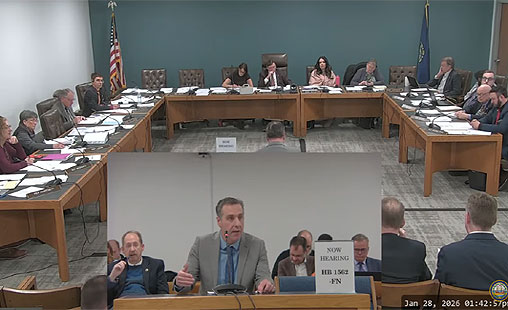
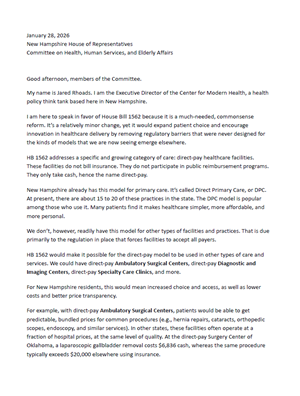
Note: The Center for Modern Health was recently invited to testify before the New Hampshire House Health, Human Services, and Elderly Affairs Committee in support of House Bill 1562. The bill would remove regulatory barriers that prevent direct-pay healthcare facilities from operating outside the insurance and public reimbursement system. Below is the text of our prepared remarks. You can also view the text of the bill and watch the video of the testimony.
Good afternoon, members of the Committee.
My name is Jared Rhoads. I am the Executive Director of the Center for Modern Health, a health policy think tank based here in New Hampshire.
I am here to speak in favor of House Bill 1562 because it is a much-needed, commonsense reform. It’s a relatively minor change, yet it would expand patient choice and encourage innovation in healthcare delivery by removing regulatory barriers that were never designed for the kinds of models that we are now seeing emerge elsewhere. HB 1562 addresses a specific and growing category of care: direct-pay healthcare facilities. These facilities do not bill insurance. They do not participate in public reimbursement programs. They only take cash, hence the name direct-pay.
New Hampshire already has this model for primary care. It’s called Direct Primary Care, or DPC. At present, there are about 15 to 20 of these practices in the state. The DPC model is popular among those who use it. Many patients find it makes healthcare simpler, more affordable, and more personal.
We don’t, however, readily have this model for other types of facilities and practices. That is due primarily to the regulation in place that forces facilities to accept all payers.
HB 1562 would make it possible for the direct-pay model to be used in other types of care and services. We could have direct-pay Ambulatory Surgical Centers, direct-pay Diagnostic and Imaging Centers, direct-pay Specialty Care Clinics, and more.
For New Hampshire residents, this would mean increased choice and access, as well as lower costs and better price transparency.
For example, with direct-pay Ambulatory Surgical Centers, patients would be able to get predictable, bundled prices for common procedures (e.g., hernia repairs, cataracts, orthopedic scopes, endoscopy, and similar services). In other states, these facilities often operate at a fraction of hospital prices, at the same level of quality. At the direct-pay Surgery Center of Oklahoma, a laparoscopic gallbladder removal costs $6,836 cash, whereas the same procedure typically exceeds $20,000 elsewhere using insurance.
I also mentioned the example of direct-pay Diagnostic and Imaging Centers. In other states, these imaging centers charge a few hundred dollars for imaging instead of thousands of dollars, because by operating outside of the third-party payer system, they avoid hospital facility fees and insurance billing complexity.
If it’s not clear why the all-payer requirement prevents these models from flourishing, allow me to offer an analogy. Imagine it was the case in New Hampshire that farmers markets are allowed, but in addition to accepting cash, every vendor was legally required to accept credit cards, EBT cards, and reimbursements from contracts negotiated with national chains. Technically, customers could still pay cash. But the whole point of a farmers market is that it avoids all the extra infrastructure, and that keeps prices down. If you require all that payment infrastructure, you lose the benefit of the direct-pay model.
HB 1562 would expand access, make healthcare more affordable, and give patients more control over their health journey.
For these reasons, I support this bill.
Thank you for your time.
Jared Rhoads