The Doctor is In, But She Can't See You
Why I can't pull your splinter and keep my job, and how to fix it.
View/Download [PDF]
Smith, C. "The Doctor is In, But She Can't See You" Center for Modern Health. February 2026.
Lately, I've been fantasizing about being the urgent care doctor for my apartment building in the city. As an emergency medicine doctor, I could stop a nosebleed or fix a finger after it's sustained an avocado-seed-removal-related laceration—all from the comfort of my own home building.
At VertiCare, I could treat your mild asthma exacerbation or begin the treatments before an ambulance arrives if it's bad enough for a hospital visit. I would get to know all of my neighbors. I could act as a bridge between primary care (to explain new medications) or emergency care (yes, you should call 911 because these symptoms could be a stroke). While I wouldn't be able to give blood transfusions, sedation to reduce an open fracture, or diagnose appendicitis, as I might in the emergency department, I could treat urinary tract infections, change dressings on wounds, or remove glass splinters from feet. All of this would be done quickly and conveniently from the comfort of our own home(ish). Plus, my side hustle, Aerie Health, could bring in a bit of spending money—to get my nails done. As an added benefit, it would help primary care doctors and offload busy emergency departments.
The only way for my Urban Urgent business to succeed would be if I were paid in cash. (I also accept checks, PayPal, Zelle, or Venmo.) The beauty of this business is that its low overhead would allow me to charge below-market rates and the cost of materials.1 Billing insurance, Medicare, and Medicaid would add too much overhead. The paperwork, prior authorizations, and billing intricacies of these various systems would require me to hire staff. I'd spend more time doing paperwork than it would take me to get the eyelash out of your eye and prescribe you an ointment.
But I can't start my cash-pay Sky High Clinic, because if I did, I would have to quit my job in the emergency department. That's because the federal government, in its infinite wisdom, has declared that any doctor who accepts Medicare or Medicaid for any patient must accept Medicare and Medicaid for all patients, regardless of the location or situation.2
Because of this rule, doctors in the US are effectively prohibited from simultaneously working in cash-pay practices and traditional practices that accept Medicare and Medicaid. I cannot maintain a cash-pay practice as the urban urgent care doctor for my building while also working shifts in the emergency department, where I am required to accept Medicare and Medicaid.
If I want to fulfill my dreams of opening RiseHigh Health Care, I must "opt out" of Medicare and Medicaid, and leave my emergency department job. You're either in or you're out.
There are reasons I might be tempted to leave the emergency department. Much of the work involves refilling prescriptions and getting X-rays of probably not broken, but twisted ankles, which is pretty similar to Mile High Health's services. The work can be stressful, and the hours are awful—weekends, holidays, nights—circadian rhythm be damned.
But the emergency department is also intense, challenging, and exciting. It involves catching dangerous diseases, collaborating with talented colleagues, teaching students and residents, and saving lives. Recently, I noticed a young patient's heart attack that the EKG algorithm missed, and my team and I saved the life of a pregnant woman with toxic shock syndrome. (The one you get from leaving a tampon in for too long.) My apartment-building-urgent-care business, Suite Relief, would be interesting, fun, and easy, but it couldn't replace the rollercoaster experience of working in the emergency department.
Unlike me, some doctors choose to opt out of Medicare and Medicaid, leaving the emergency department (or other overworked traditional practices) behind for greener pastures—urgent care clinics or direct cash-pay gigs. The reason could be any one of the hardships of working in the emergency department: lack of a predictable schedule, loss of family time working nights, holidays, weekends, dealing with the overpowering sense of inadequacy and loss after witnessing death(s), or the never-ending onslaught of patients who aren't satisfied (as evidenced by those Press Ganey surveys). That list isn't exhaustive, and it isn't entirely specific to the emergency department. Other specialities have their own and similar challenges. However, these are among the reasons that emergency medicine doctors retire, on average, 15 to 25 years earlier than colleagues in other fields.
Emergency medicine doctors aren't the only ones facing this "you're in or opted out" issue with Medicare and Medicaid. An internal medicine doctor with a specialization in infectious disease cannot work as a cash-pay or direct primary care doctor and also take one week a month of infectious disease consults for a local hospital, where he will be required to accept Medicare and Medicaid. A gastroenterologist cannot contract with a direct primary care practice to offer a special cash rate for screening colonoscopies and also work in an academic teaching hospital where he must accept—you guessed it—Medicare and Medicaid.
What does this mean for Skyscraper First Health services?
For one, since I must maintain my enrollment in Medicare and Medicaid, I can't just remove the roach from someone's ear and send them a $50 Venmo bill. I have to ask first if they're on Medicare or Medicaid. If they are, I cannot help them; I must send them away. They will simply have to take themselves and their roach to the hospital to face a three-hour wait with a tickle in their ear.
However, even this might be too great a risk. Because, if a patient lies to me or makes a mistake and forgets their insurance,3 (because she's been sleepwalking and hit her head on the refrigerator at 1 am, causing her to forget that the Medicare coverage had kicked in the day before, on her 65th birthday) I'm still the one held liable and at risk of being charged with fraud. I could be kicked out of Medicare and Medicaid, and face fines that are much more than I would ever charge my patients. In extreme cases, I could even lose my medical license—bye-bye emergency department. The risk of attempting cash-pay STATellite Care without opting out of Medicare and Medicaid isn't worth it after all the (eleven) years I put in getting to this point in my career.
Alternatively, I could choose to bill Medicare or Medicaid, since I'm enrolled in both for my regular job. But then I'd have to collect the insurance information, verify coverage, fill out and submit insurance claim forms, wait to be paid for months, probably hire an assistant and therefore raise prices, and likely not even recoup the cost of materials. (Yes, I need materials—lidocaine to poison the roach first, and I'm not using my fingers to get it. EEEEW!) This makes my simple cash-pay business so much more complicated and unenjoyable that it's not worth the effort.
Why do these rules and regulations exist at all?
Many of these regulations are attempts to protect patients (especially those with low incomes) from exploitation and to protect the government programs from fraud. I agree that being paid by both the patient and Medicare for the same service (or ‘double-dipping') is fraud. However, double-dipping still occurs despite these rules intended to prevent it. I understand concerns that patients could be taken advantage of in an emergency, or might not realize they could get a similar service for free if they used their insurance. And I wouldn't balk at taking extra steps to be especially transparent to avoid those scenarios.
But suppose a patient has signed up in advance (not at the moment of urgency) and clearly understands the nature of the arrangement. (They can't request reimbursement from Medicare and Medicaid, and a list of my charges compared to the usual Medicare cost-sharing rate or nothing with Medicaid.) In that case, I don't see this additional option for them (to have the prickly pear cactus needles removed from their arm at 7am for $50 in their own apartment so they can get to work on time) as problematic.
First, I'd be making my life better by earning a little money for a service that's easy and convenient for me to provide. Second, I'd be improving my patients' lives by delivering convenient, timely medical care at a transparent rate. Third, I'd improve the overall healthcare situation in the U.S. by enhancing access to care, reducing emergency department visits, and saving the government (through Medicare and Medicaid) the expense of those emergency visits.
Currently, no mechanism in the U.S. allows doctors to accept Medicare and Medicaid patients in one venue but not in another.4 The laws for Medicaid in every state are slightly different, making it even more complicated for doctors to know when they are doing something that would be considered fraudulent. So many, like me, let our dreams fall away. No little local urban practice on the side, no walking the halls with my doctor bag whistling Twisted Nerve, no refilling blood pressure medications or helping you change the dressing on your chronic leg ulcer for me.
In many other countries, doctors can work in both public and private healthcare systems. Singapore and the United Kingdom are two countries that make it very easy.5 I struggle to understand why some version of allowing doctors to have separate, parallel cash pay and traditional practices isn't possible in the US.
Imagine if I could do things my way? It could expand access and choices for patients, encourage healthcare innovation, reduce costs, and alleviate the burden on our overworked emergency departments and primary care clinics.
Why not make explicit changes to the federal law?
The law could be amended to allow providers' enrollment and billing in Medicare and Medicaid to be linked to specific patients (similar to the United Kingdom) or specific business licenses (similar to Singapore).
In the United Kingdom, this is accomplished through "A Code of Conduct for Private Practice," which stipulates, by its very existence, that physicians may maintain both public and private relationships with patients. It defines the ethical and legal responsibilities of physicians when organizing these relationships within their practice in the government-funded National Health Service.
In Singapore, physicians are allowed to practice in private and public systems through two mechanisms. A Family Practice Plan that is similar to the United Kingdom's system, wherein doctors working primarily in publicly funded centers may bring in a portion of private patients. And separately through licensing mechanisms.6 If a doctor works for a public hospital, they would have a license (or employee exemption, depending on their role) for that work. For their separate telemedicine practice, the physician would require a different entity-specific license. The doctor's payment structure at the hospital is linked to the facility's license. The telemedicine practice's payment structure is similarly connected to its license.
Given the mixed system in the U.S. with disparate payment models, the easiest way to correct our system would be to model it after the mixed Singaporean system. This would mean that we link enrollment in Medicare and Medicaid to registered practice sites and/or healthcare entities. This wouldn't be a giant leap. I currently work in two different hospital systems, and both list their addresses on separate Medicare and Medicaid enrollment listings for me.
We would implement this by amending the Social Security Act (SSA) and the Code of Federal Regulations (CFR) through bills passed in Congress.
The regulations, as they're written, are long, somewhat convoluted, and are sometimes interpreted differently depending on the state or legal body. So I won't go into them in detail, but feel free to follow my links if you'd like to read more.
First, a paragraph should be added to SSA §1802(b) (42 U.S.C. 1395a(b)), which already defines the rights of a patient to contract with physicians. The new paragraph would specify the right of a private practice site or entity to opt out of Medicare, just as subparagraph (3) does for an individual physician. Text would be similar to subparagraph 3, and along the lines of: "(A) In general; Paragraph (1) shall not apply to any contract entered into by a physician or practitioner at the physician's registered private practice site or at a non-facility private setting linked to a private practice entity unless an affidavit described in subparagraph (B) is in effect during the period any item or service is to be provided pursuant to the contract."
The link to a business or entity would enable mobile practice settings, such as my Skyline Health, outside of facilities that provide healthcare through Medicare and Medicaid. Otherwise, the same language regarding filing affidavits, consent, duration of opt-out, enforcement, transparency, and coercion currently in subparagraph (3) could apply or be repeated in this paragraph.7
In this case, providers could still opt out of Medicare and Medicaid, but they wouldn't have to if they were working with an entity that has opted out of these programs. This would simply add a site or entity-based private path for cash- or direct-pay practices to exist. Doctors can belong to these organizations in parallel. For example, when working under Elevated Health, the cash-pay entity would be registered as a non-participating practice and would not bill Medicare or Medicaid. However, this would not affect my enrollment in Medicare and Medicaid associated with my emergency department.
Second, a section should be added to 42 CFR Part 405, Subpart D on "site-based or entity-based private contracting" that would refer to our initial paragraph and define general rules, regulations, and expectations. This would be the place to include guardrails based on international ethical codes of conduct, such as refraining from advertising for a private entity while working in a public one, protections from coercion, providing transparent and informed consent, and ensuring continuity of care. The United Kingdom and Singapore practices of informing patients about the costs they would incur if they instead used their government-sponsored services at a participating entity should also be applied.
Opening these pathways would spark small, low-overhead innovations (such as Condo Care Clinic, neighborhood house calls, nutrition services, fast-vax clinics, mobile IV hydration vans, and others that I cannot begin to imagine). These innovations would provide patients with real choices and quicker access at competitive prices. They also create a bridge back to the traditional system, where physicians in direct-pay practices can continue to teach, consult, and cover limited hospital shifts, thereby supporting the current workforce shortages. The result is a lighter primary-care burden on understaffed clinics, fewer avoidable emergency department visits, and a broader pipeline of clinicians. A few explicit statutory changes could have an untold impact on freedom, choice, and access in America's healthcare system.
What do you think of this plan? Are you a doctor, or do you know any doctors, who could benefit from legislation that allows doctors to practice simultaneously in parallel cash-pay and traditional entities?
Acknowledgments: Many thanks to Kelly Vedi, Elizabeth Van Nostrand, Smrithi Sunil, Andrew Burleson, Mike Riggs, and Travis Pew for the feedback, comments, and challenges.
References:
1. I would have an excuse to buy the portable ultrasound probe that works with my phone (that no one will get me for my birthday!) and the mini EKG machine (for the gastritis causing chest pain—although in the case of a heart attack, you'd also have a leg up because I'd start your treatment and get to the hospital without delay, EKG in hand).
2. SSA §1848(g)(4)(A) and 42 U.S.C. §1395a(b) and 42 CFR Part 405, Subpart D (see opt out requirements and emergency contract sections)
3. You may be surprised to learn that a patient could not be aware they have Medicare or Medicaid coverage. However, many states with Medicaid expansion use private companies (such as Aetna and Fidelis) to manage those plans, and patients often don't realize it counts as Medicaid. Additionally, elderly patients with low incomes, referred to as "Qualified Medicare Beneficiaries (QMB)," have Medicare with a Medicaid-like state coverage as secondary insurance that helps cover their cost-sharing. Often, these patients aren't aware of this. Many mistakenly think that everything switched to Medicare only when they turned 65. Doctors who have opted out of Medicare and Medicaid can legally contract with Medicare-only patients, but NOT with QMB patients, and in many states, not with Medicaid patients.
4. Technically, there is a carve-out for this in federal systems (VA, military hospitals) and in the event of an emergency. However, no hospital will hire an opt-out doctor to work in the emergency department, except in the most dire circumstances—it's too complex.
5. As does Germany (but I can't read the German PDF to verify ChatGPT's claims), China, Australia, UAE.
6. Here is an overview. Scroll down to the section titled "Who needs to hold an HSCA license?" for a description showing that doctors working as employees for a publicly funded entity are exempt, and the entity may still bill for their service. Here is the actual HSCA code, which includes patient protections, regulations, and requirements. Singapore also has a Handbook on Medical Ethics that summarizes many of these guidelines in plain language.
7. Stark Laws would not apply to the new private entity that does not accept Medicare and Medicaid. The Antikickback Statute would still apply, as it currently does for doctors who have opted out of Medicare and Medicaid. These acts are intended to prevent financial inducements for referrals. Doctors would have to be careful not to refer patients specifically to the facility at which they accept Medicare and Medicaid. The Sunshine Act, which requires the disclosure of financial conflicts of interest, would still apply.
This article also appears on Dr. Colleen Smith's Substack.
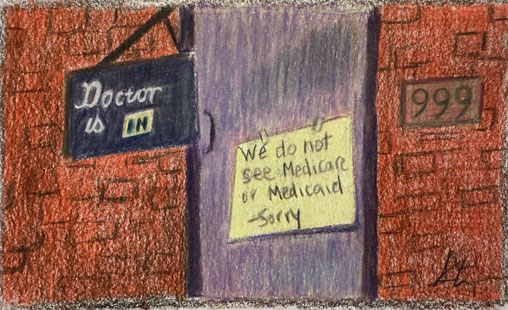
Featured image is "The Doctor Is In" by Colleen Smith. Colored Pencil.